
When to Replace Spark Plugs on a Gas Truck (And What Happens If You Wait)
Spark plugs should be replaced at 60,000 miles on turbocharged engines (Ford EcoBoost, Chevy 2.7L Turbo) and 90,000-100,000 miles on naturally aspirated V8s (5.3L EcoTec3, 5.7L HEMI, 5.0L Coyote). Towing regularly or running E85 shortens both intervals by 30-40%. Waiting past these marks risks misfires, reduced fuel economy, and catalytic converter damage that can cost more than $1,500 to repair.
Quick answer: replace spark plugs at 60,000 miles on turbocharged engines (EcoBoost, 2.7L Silverado Turbo) and 90,000-100,000 miles on naturally aspirated V8s. Towing regularly or running E85 shortens both intervals by 30-40%. Waiting risks misfires, reduced fuel economy, and catalytic converter damage that can cost more than $1,500 to repair.
Most gas truck owners know spark plugs need replacing eventually. What they don't know is what happens to the rest of the engine when they wait too long. This guide breaks down the correct interval for every major gas truck engine, the warning signs your plugs are already overdue, and why the stakes are higher on modern turbocharged engines than they were on the V8s of a decade ago.
Spark Plug Intervals by Engine: What Your Truck Actually Needs
Not all gas truck engines share the same spark plug interval. The biggest variable is whether your engine is turbocharged or naturally aspirated. Turbo engines run hotter combustion cycles and put more stress on plugs, which shortens their effective life significantly.
| Engine | Truck | Standard Interval | Severe Duty / Towing |
|---|---|---|---|
| 2.7L EcoBoost | F-150 | 60,000 mi | 40,000–45,000 mi |
| 3.5L EcoBoost | F-150 | 60,000 mi | 40,000–45,000 mi |
| 5.0L Coyote V8 | F-150 | 90,000–100,000 mi | 60,000–70,000 mi |
| 2.7L Turbo | Silverado 1500 | 60,000 mi | 40,000–45,000 mi |
| 5.3L EcoTec3 V8 | Silverado 1500 | 97,500–100,000 mi | 60,000–70,000 mi |
| 6.2L EcoTec3 V8 | Silverado 1500 | 97,500–100,000 mi | 60,000–70,000 mi |
| 5.7L HEMI V8 | Ram 1500 | 90,000–100,000 mi | 60,000–70,000 mi |
Does Running E85 Change the Interval?
Yes, significantly. E85 flex fuel burns cooler than gasoline, which sounds like it would be easier on plugs. The problem is that E85 requires a much richer fuel mixture, which increases combustion byproduct deposits on the electrode. Owners who run E85 regularly should treat 40,000-45,000 miles as their ceiling on any engine, turbocharged or not.
What "Severe Duty" Actually Means
Ford, GM, and Ram all define severe duty in their owner's manuals, and the definition is broader than most owners expect. You're in severe-duty territory if any of the following apply:
- Towing a trailer or hauling heavy payloads regularly
- Frequent stop-and-go driving or short trips under 10 miles
- Extended idling (job sites, cold climates)
- Driving in extreme heat (above 90°F) or extreme cold (below 0°F)
- Operating on dusty roads or unpaved surfaces
What Happens When You Wait Too Long?
This is the part most "replace at X miles" articles skip entirely. Worn spark plugs don't just make your engine run slightly less efficiently — they trigger a chain of secondary failures that can turn a $60-100 plug replacement into a $1,500-3,000 repair bill.
The Catalytic Converter Problem
When a spark plug wears past its usable life, the spark gap widens and the plug fires inconsistently. That inconsistency causes misfires, where fuel enters the cylinder but doesn't fully combust. That unburned fuel exits through the exhaust and enters the catalytic converter, where it ignites at temperatures the converter was never designed to handle.

TURBOCHARGED ENGINES HAVE LESS MARGIN FOR ERROR
On a naturally aspirated V8 like the 5.0L Coyote or 5.7L HEMI, a misfiring cylinder is a serious problem. On a turbocharged engine like the EcoBoost or 2.7L Silverado, it's worse. The turbocharger amplifies combustion pressure, which means a plug that's marginal under normal conditions will misfire under boost. Owners often notice this as a hesitation or stumble during hard acceleration, exactly when the turbo is spooling up.
The result is reduced boost response, lower fuel economy, and accelerated wear on ignition coils. Coils that fire repeatedly trying to compensate for a weak plug fail faster, adding another $80-150 per coil to the repair cost.
The 5.3L AFM Interaction: for Silverado owners with the 5.3L V8 and Active Fuel Management, worn spark plugs create an additional risk. AFM deactivates cylinders at light throttle to improve fuel economy, and when plugs are worn, the transition in and out of cylinder deactivation becomes rougher, putting additional stress on the AFM lifters. The 5.3L AFM lifter failure is already a known issue on high-mileage engines; neglecting plug intervals accelerates it. Lifter replacement runs $2,000-4,000 at a shop.

HOW DO YOU KNOW YOUR PLUGS ARE OVERDUE?
Your truck won't throw a check engine light until a plug has already failed badly enough to trigger a misfire code. By that point, you've already been running on a degraded plug for some time. Watch for:
- Rough idle at startup: a slight stumble or vibration when the engine is cold is often the first sign of uneven combustion from a worn plug
- Hesitation under acceleration: stumbling or surging when you get on the throttle, especially under load, points to a misfiring cylinder
- Reduced fuel economy: a noticeable drop in MPG without a change in driving habits — worn plugs force the engine to compensate with richer fueling
- Hard starting in cold weather: a plug that fires adequately when warm may struggle at 20°F
- Check engine light with a P030X code: a P0301, P0302, P0303, etc. code indicates a cylinder-specific misfire — a plug has already crossed from worn to failing
If you're seeing any of these symptoms and your truck has more than 50,000 miles on the original plugs, replace them before diagnosing anything else. Spark plugs are the lowest-cost item to rule out, and they're responsible for a disproportionate number of drivability complaints.
OEM vs. Aftermarket Plugs: Does the Brand Matter?
For modern gas truck engines, plug material matters more than brand. The key distinction is iridium vs. copper.
Why Iridium Is the Right Choice for Modern Engines
All three major gas truck platforms (EcoBoost, EcoTec3, HEMI) are factory-equipped with iridium or iridium-tipped plugs for a reason. Iridium has a much higher melting point than copper, which means the electrode holds its shape longer under the heat and pressure of turbocharged combustion. Copper plugs are cheaper, but they wear faster and require more frequent replacement, negating the cost savings.
Stick to OEM Specifications
For plug gap and heat range, follow OEM spec exactly. Modern engine management systems are calibrated for a specific plug gap — running a plug with a wider or narrower gap than specified throws off ignition timing calculations and can introduce the same symptoms you're trying to fix. Most quality iridium plugs come pre-gapped; verify before installation. A good rule of thumb: if the plug isn't listed in your truck's service manual or the manufacturer's fitment guide, don't use it.
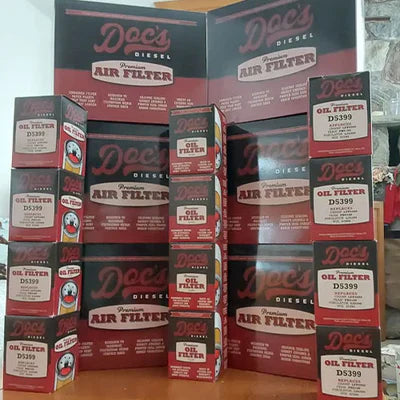
Pairing a fresh set of spark plugs with a clean gas engine air filter is the most effective two-item tune-up for any gas truck. Both affect combustion quality; both are often neglected past their service interval.
Round Out the Tune-Up: Shop Gas Truck Air Filters
Doc's Diesel doesn't stock spark plugs, but a fresh engine air filter is the other half of the combustion-quality equation, and it's OEM-fit for F-150, Silverado 1500, and Ram 1500. Enter your year, make, and model in the vehicle selector to confirm exact fit, or add a verified in-stock filter straight to cart below.

MaxFlow Performance Engine Air Filter
$23.99
The other half of a combustion-quality tune-up — enter your year, make, and model at checkout to confirm exact fit.
Why It Matters
- MaxFlow performance media — sourced to spec
- Pairs with a fresh plug set — confirm exact fit with the vehicle selector at checkout
Gas trucks & SUVs · verify fitment with the vehicle selector
30-Day Money-Back Guarantee
SHOP GAS TRUCK AIR FILTERS


Frequently Asked Questions
Every 60,000 miles under normal use. If you tow regularly, run E85, or drive severe duty, cut that to 40,000-45,000 miles.
90,000-100,000 miles under normal use (5.0L Coyote, 5.3L/6.2L EcoTec3, 5.7L HEMI). Towing or severe-duty driving shortens that to 60,000-70,000 miles.
Yes. E85 requires a much richer fuel mixture, which increases combustion byproduct deposits on the electrode. Owners who run E85 regularly should treat 40,000-45,000 miles as their ceiling on any engine, turbocharged or not.
Worn plugs cause misfires, which send unburned fuel into the catalytic converter where it ignites at temperatures the converter wasn't designed for. A single extended misfire event can destroy a converter. Catalytic converter replacement runs $800-1,500 per side, and most trucks have two — a $100 plug job can become a $3,000 repair.
Worn plugs make the transition in and out of cylinder deactivation rougher, which puts additional stress on the AFM lifters and accelerates an already-known failure mode on high-mileage engines. Lifter replacement runs $2,000-4,000, versus a fraction of that for plugs.
Iridium. It has a much higher melting point than copper, so the electrode holds its shape longer under the heat and pressure of turbocharged combustion. Copper plugs wear faster and negate any cost savings — never substitute copper in a turbocharged engine.
OVER 500,000+ HAPPY CUSTOMERS
“I use the filters and oil kits to service my fleet of trucks (4). I own a landscaping company and we are hard on our trucks, and it's nice to have a convenient way to buy the correct amount of oil and all filters in one place.”
Kameron C.
“Easy to order, had a question got a call back very quickly and product was very nice stuff! Definitely will continue ordering my oil changes through docs 👍”
Dakota W.
ENTER YOUR TRUCK. WE'LL FIND YOUR FILTERS.