

How Towing Changes Your Truck's Maintenance Schedule (And What the Dash Warning Won't Tell You)
Ford, GM, and Ram all publish two sets of service intervals: a normal schedule and a severe-duty schedule, and towing is listed as a severe-duty trigger in every one of their owner's manuals. That means oil, transmission, brake fluid, and differential intervals all compress the moment hauling becomes a regular habit — and the oil life monitor on your dash doesn't know you're towing. Owners who rely on it alone often run 2,000-3,000 miles past where the severe schedule says to stop.
Quick answer: towing puts a truck on the severe-duty maintenance schedule immediately, not after a certain mileage or trailer weight. Ford, GM, and Ram all define regular towing as a severe-duty trigger, which cuts the oil change interval to roughly 5,000 miles, the transmission fluid interval to about half the normal figure, and moves brake fluid replacement from every 3 years to every 2.
You're Already on the Severe Schedule
Every major truck manufacturer defines severe duty in the owner's manual, and the definition is broader than most people expect. It's not just commercial fleet trucks or construction rigs. If you regularly do any of the following, you qualify:
- Tow a trailer, boat, camper, or equipment
- Haul heavy payloads in the bed
- Drive in stop-and-go traffic frequently
- Operate in extreme heat or cold
- Drive on dusty or unpaved roads
- Let the engine idle for extended periods
Most owners who tow a travel trailer on weekends or pull a boat to the lake every other week are firmly in severe-duty territory. GM is direct about it: the severe schedule applies the moment you regularly tow a trailer, regardless of how light the load is.
What "Severe" Actually Means for Intervals
The gap between normal and severe intervals isn't a 10% adjustment. For some fluids, the severe schedule cuts the interval in half or more.
| Service Item | Normal Interval | Severe/Towing Interval |
|---|---|---|
| Engine Oil & Filter | 7,500–10,000 mi | 5,000 mi (gas); 3,750 mi (some engines) |
| Transmission Fluid | 60,000+ mi | 30,000–45,000 mi |
| Differential Fluid | 60,000+ mi | 45,000 mi |
| Transfer Case Fluid | 45,000+ mi | 30,000 mi |
| Brake Fluid | Every 3 years | Every 2 years |
| Engine Air Filter | 45,000 mi | 22,500 mi |

THE OIL LIFE MONITOR DOESN'T KNOW YOU'RE TOWING
Ford's Intelligent Oil-Life Monitor, GM's Oil Life System, and Ram's oil change indicator all work by tracking engine data: rpm, temperature, cold starts, and run time. They're genuinely useful for normal driving. Under towing, they have a real limitation — none of them have a trailer sensor. They can't see the extra thermal load your engine carries pulling 8,000 lbs uphill in 95-degree heat, and they can't account for the heat cycling your transmission fluid goes through every time you brake on a long descent.
The algorithm was calibrated for typical driving patterns, and towing is not typical. The practical result: the dash light may show 40% oil life remaining when your oil is already degraded past where it should be for a truck under towing stress. Ford's own documentation acknowledges that under severe use, owners should not wait for the monitor and should plan on 5,000-mile intervals as a ceiling.
What the monitors miss: elevated sustained heat from extended towing at highway speeds, transmission fluid condition (the monitor only tracks engine oil), brake fluid moisture absorption, and differential/transfer case fluid degradation from load stress. None of these systems have their own dash warning until something has already gone wrong.
Ram's hard limit: under no circumstances should oil change intervals exceed 10,000 miles or 12 months on Ram 1500 models, even under normal conditions. Under severe duty, the change oil message can trigger as early as 3,500 miles. For Silverados with AFM/DFM cylinder deactivation on the 5.3L, the case for 5,000 miles is even stronger — see the full Silverado 1500 AFM/DFM maintenance schedule for why.

TRANSMISSION FLUID: THE MOST VULNERABLE SYSTEM UNDER TOW
Pulling a heavy trailer forces the transmission to work harder, shift more frequently, and generate significantly more heat than normal driving. Transmission fluid breaks down from that heat, and once degraded, it loses its ability to protect clutch packs and prevent slippage. The real-world failure mode is transmission slip and shudder — by the time you feel it, the damage is done. Fluid changes are cheap compared to a rebuild.
Under normal conditions, most truck transmissions are rated for 60,000 miles or more before a fluid change. Under towing, every major OEM cuts that interval:
- Chevrolet Silverado (8L90, 10L80, 10L90): 45,000 miles severe, 30,000 miles for regular towing use
- Ram 1500 (8-speed automatic): 60,000 miles severe duty
- Ford F-150 (10R80): severe duty interval per owner's manual, generally 60,000 miles with earlier inspection for towing
Brake Fluid and Differential Wear Under Tow
Brake Fluid
Brake fluid is the most overlooked maintenance item on trucks that tow. It's hygroscopic, meaning it absorbs moisture from the air over time. As moisture content rises, the fluid's boiling point drops — when you're braking hard to slow a loaded truck and trailer on a long downhill grade, that lower boiling point becomes a real problem: vapor lock, reduced pedal feel, and in extreme cases, brake fade. Most OEM schedules call for brake fluid replacement every 3 years under normal conditions; the severe-duty recommendation from GM and Ram drops that to every 2 years for trucks that tow regularly. Trucks with electric trailer brake controllers work the brake system even harder than the numbers suggest.
Differential and Transfer Case Fluid
Four-wheel-drive trucks that tow have two additional fluid systems that degrade under load: the front and rear differentials, and the transfer case. These are easy to overlook because they don't have a warning light and don't produce obvious symptoms until wear is advanced. GM specifies differential fluid inspection at 45,000 miles for towing trucks, with replacement at that same interval rather than the later normal-schedule date. Transfer case fluid follows a similar pattern, with GM recommending 30,000 miles for towing use versus a longer normal interval. The failure mode here is bearing and gear wear from degraded lubrication — gradual, quiet, and expensive when it finally surfaces.
Severe-Duty Intervals by Truck: F-150, Silverado, and Ram 1500
The intervals above are generalizations. Here's how the severe schedule breaks down for each of the three most common gas half-ton trucks.
Ford F-150
Ford's Intelligent Oil-Life Monitor is one of the more sophisticated systems on the market, but Ford's own documentation is clear: under severe use including towing, plan on 5,000 miles as the ceiling and don't wait for the monitor to prompt you. The 10R80 10-speed automatic is a capable transmission, but it runs hot under trailer loads and benefits from earlier fluid inspection. See the full F-150 maintenance schedule for the engine-by-engine breakdown.
| Service Item | F-150 Severe Interval |
|---|---|
| Engine Oil & Filter | 5,000 mi (don't wait for monitor) |
| Transmission Fluid | Per manual; inspect at 60,000 mi |
| Brake Fluid | Every 2 years for towing use |
| Engine Air Filter | Inspect at 22,500 mi |
| Differential Fluid | Per manual; inspect at 60,000 mi |
Chevrolet Silverado 1500
GM is the most explicit of the three brands about the severe schedule, stating directly that it applies the moment you regularly tow. For the 5.3L EcoTec3 with AFM/DFM, 5,000 miles is the practical ceiling under towing, with some sources recommending 3,750 miles for trucks that tow frequently at high loads — full detail in the Silverado 1500 AFM/DFM service guide.
| Service Item | Silverado 1500 Severe Interval |
|---|---|
| Engine Oil & Filter | 3,750–5,000 mi |
| Transmission Fluid (8L90/10L80/10L90) | 30,000 mi for towing |
| Brake Fluid | Every 2 years |
| Front/Rear Differential | Replace at 45,000 mi |
| Transfer Case Fluid | 30,000 mi for towing |
| Engine Air Filter | 22,500 mi |
Ram 1500
Ram's severe schedule is among the most conservative. The change oil message can trigger as early as 3,500 miles under severe conditions, with a hard cap of 10,000 miles or 12 months regardless of what the monitor shows. The EcoDiesel variant runs shorter intervals across the board (6,000-8,000 miles) because diesel oil degrades faster under load.
| Service Item | Ram 1500 Severe Interval |
|---|---|
| Engine Oil & Filter (gas) | 5,000 mi; monitor may trigger at 3,500 mi |
| Engine Oil & Filter (EcoDiesel) | 6,000–8,000 mi |
| Transmission Fluid (8-speed) | 60,000 mi severe duty |
| Brake Fluid | Every 2 years for towing |
| Front/Rear Differential | Per manual; inspect at 45,000 mi |
Towing Maintenance Checklist: What to Track and When
If you tow regularly, the simplest thing you can do is stop relying on the dash and start tracking mileage manually. Here's a practical checklist built around the severe-duty intervals above.
Every 5,000 Miles (or 6 Months)
- Engine oil and filter change
- Tire rotation and pressure check (loaded tire wear is uneven)
- Visual inspection of brake pads and rotors
- Check transmission fluid level and condition (color, smell)
- Inspect trailer hitch hardware and ball mount for wear
Every 15,000-22,500 Miles
- Engine air filter inspection and replacement if needed
- Cabin air filter replacement
- Fuel filter inspection (diesel trucks: replace at 25,000 miles)
- Coolant level and condition check
Every 30,000 Miles
- Transfer case fluid change (4WD trucks that tow)
- Transmission fluid change (Silverado towing use; inspect all trucks)
- Brake fluid moisture test; replace if above 3% or every 2 years
Every 45,000 Miles
- Front and rear differential fluid replacement
- Transmission fluid replacement (all towing trucks if not done at 30k)
- Inspect suspension components and wheel bearings
Annual (Regardless of Mileage)
- Battery load test (towing draws more electrical load)
- Belt and hose inspection
- Brake fluid replacement if you haven't tested moisture content
The pattern here is straightforward: the more a system is stressed by towing, the shorter its service interval. The trucks that hold up best over 200,000 miles are the ones where the owner treated the severe schedule as the default, not the exception.
Shop Gas Truck Filters & Kits for Towing
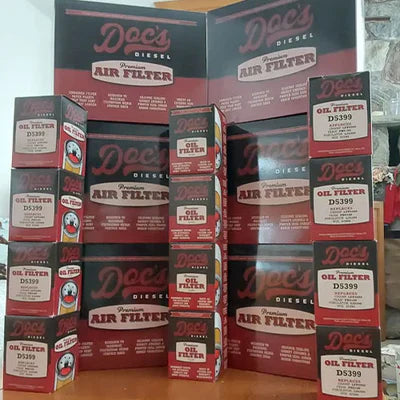
Staying on top of these intervals is easier when you're not hunting down individual parts every time. Doc's Diesel maintenance kits are built around the actual service needs of working trucks, with OEM-fit oil filters, engine air filters, and additives packaged for the intervals that matter. Enter your year, make, and model in the vehicle selector for your exact kit.
SHOP GAS TRUCK FILTERS & KITS


Frequently Asked Questions
Yes, immediately, not after a certain mileage or trailer weight. Ford, GM, and Ram all define regular towing as a severe-duty trigger in their owner's manuals. GM is the most explicit: the severe schedule applies the moment you regularly tow a trailer, regardless of how light the load is.
5,000 miles is the practical ceiling for gas-powered F-150s, Silverados, and Ram 1500s under regular towing. For AFM/DFM-equipped Silverado 5.3L engines, some sources recommend as little as 3,750 miles for frequent high-load towing. Ram caps oil changes at 10,000 miles or 12 months even under normal conditions, and the change oil message can trigger as early as 3,500 miles under severe duty.
The monitors track engine data like rpm, temperature, cold starts, and run time, but none of them have a trailer sensor. They can't see the extra thermal load from pulling a heavy trailer or the heat cycling your transmission and brake fluid go through under sustained towing. The algorithm is calibrated for typical driving, and towing isn't typical.
Roughly half the normal interval. Where normal driving allows 60,000+ miles, towing cuts that to 30,000-45,000 miles depending on platform — the Silverado's 8L90/10L80/10L90 is rated for 30,000 miles under regular towing use. Heat from hauling breaks down the fluid's ability to protect clutch packs, and the failure mode is slip and shudder that shows up only after the damage is done.
Test the moisture content with a $10 tester from any auto parts store. If the reading is above 3%, replace it regardless of age. As a baseline, flush brake fluid every 2 years if you tow regularly, versus every 3 years under normal conditions — moisture absorption lowers the boiling point and can cause fade under heavy braking with a loaded trailer.
Towing puts additional stress on the oil in AFM/DFM-equipped engines, and extended oil change intervals under load are closely tied to the lifter failures that have affected neglected 5.3L engines. That makes the 5,000-mile ceiling non-negotiable for towing Silverado owners — see the full Silverado 1500 AFM/DFM guide for the cost breakdown.
OVER 500,000+ HAPPY CUSTOMERS
“I use the filters and oil kits to service my fleet of trucks (4). I own a landscaping company and we are hard on our trucks, and it's nice to have a convenient way to buy the correct amount of oil and all filters in one place.”
Kameron C.
“Easy to order, had a question got a call back very quickly and product was very nice stuff! Definitely will continue ordering my oil changes through docs 👍”
Dakota W.
TOWING? WE'LL FIND YOUR MAINTENANCE KIT.